


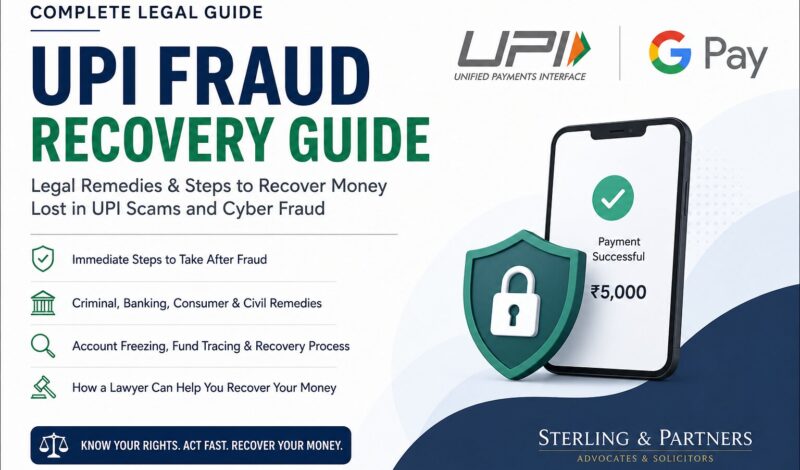

UPI Scam, Online Banking Fraud, QR Code Fraud and Cyber Crime Recovery – Legal Remedies, Recovery Process and Immediate Action Plan
Introduction
The rapid adoption of Unified Payments Interface (UPI) has revolutionised digital transactions in India. Today, individuals and businesses rely on UPI platforms such as Google Pay, PhonePe, Paytm, BHIM and various banking applications for instant fund transfers.
However, the rise of digital payments has also led to an unprecedented increase in cyber-enabled financial crimes. Every day, thousands of individuals fall victim to QR code scams, phishing attacks, fake customer care frauds, social media marketplace scams, impersonation frauds, investment scams and unauthorised banking transactions.
A common misconception among victims is that once money has been transferred through UPI, recovery is impossible.
That is incorrect.
In many cases, funds can be traced, beneficiary accounts can be frozen, criminal investigations can be initiated and legal proceedings can be pursued for recovery. However, the success of recovery efforts often depends upon how quickly the victim acts and how effectively the available legal remedies are utilised.
This article provides a comprehensive guide to UPI fraud recovery in India, with a particular focus on the legal remedies available to victims.
Understanding UPI Fraud
UPI fraud generally refers to any fraudulent transaction carried out through a UPI-enabled platform by deception, impersonation, unauthorised access, phishing, social engineering or other unlawful means.
While the technology underlying UPI is highly secure, cybercriminals frequently exploit human behaviour rather than technical vulnerabilities.
Some of the most common forms of UPI fraud include:
QR Code Scams
Fraudsters send QR codes claiming that scanning them will enable the victim to receive money. In reality, scanning the QR code initiates a payment from the victim’s account.
Fake Customer Care Fraud
Victims searching for customer care numbers online are directed to fraudulent websites displaying fake helpline numbers. Fraudsters then obtain OTPs, banking credentials or remote access to the victim’s device.
Remote Access Application Scams
Victims are persuaded to install applications that allow fraudsters to control their devices and access banking applications.
KYC Update Fraud
Victims receive messages claiming that their bank account, wallet or UPI account requires urgent KYC verification. The victim is directed to a fraudulent website where credentials are stolen.
Marketplace and Social Media Scams
Fraudsters impersonate buyers on platforms such as OLX, Facebook Marketplace, Instagram and WhatsApp and deceive sellers into authorising payments.
Investment and Trading Frauds
Victims are induced to transfer funds into fraudulent investment platforms promising unrealistic returns.
Impersonation and Emergency Fraud
Fraudsters impersonate family members, employers, government officials or law enforcement authorities and create urgency to extract payments.
Immediate Steps to Take After Discovering a UPI Fraud
The first few hours after a cyber fraud are often the most critical.
Many recovery actions become significantly more difficult once funds are withdrawn, transferred across multiple accounts or converted into cryptocurrency.
Victims should immediately take the following steps:
Step 1: Call the National Cyber Crime Helpline – 1930
This should be done immediately upon discovering the fraud.
The 1930 helpline is integrated with the national cyber fraud reporting mechanism and facilitates rapid communication with banks and financial institutions for freezing suspicious transactions.
Do not wait for legal advice before making this report.
Time is critical.
Step 2: File a Complaint on the National Cyber Crime Reporting Portal
The complaint should be lodged without delay through:
Ensure that the following information is provided:
- Transaction ID
- UTR number
- Date and time of transaction
- Fraudster’s mobile number
- UPI ID
- Screenshots
- Communication records
Preserve the acknowledgement generated by the portal.
Step 3: Notify Your Bank Immediately
The victim should immediately:
- Contact customer care
- Raise a fraud dispute
- Request investigation
- Seek freezing of beneficiary accounts wherever possible
- Obtain complaint reference numbers
Written communication with the bank should be preserved.
Step 4: Preserve All Evidence
Victims should retain:
- Bank statements
- SMS alerts
- UPI transaction details
- WhatsApp chats
- Emails
- QR codes
- Call recordings
- Screenshots
- Complaint acknowledgements
Evidence preservation is often crucial in subsequent criminal and civil proceedings.
Step 5: Consult a Lawyer Early
Many victims make the mistake of waiting several weeks before seeking legal assistance.
In cyber fraud matters, the first few days often determine whether:
- Accounts can be frozen;
- Evidence can be preserved;
- Beneficiary accounts can be identified; and
- Recovery remains possible.
Legal Remedies Available to Victims of UPI Fraud
Contrary to popular belief, cyber fraud victims are not limited to filing complaints with banks or cyber crime portals.
Indian law provides multiple parallel remedies that may be pursued simultaneously.
Criminal Remedies
Registration of FIR
Depending upon the nature of the fraud, offences may be attracted under the Bharatiya Nyaya Sanhita, 2023 and the Information Technology Act, 2000.
These may include offences relating to:
- Cheating;
- Cheating by personation;
- Identity theft;
- Forgery;
- Use of forged electronic records;
- Criminal conspiracy;
- Computer-related offences.
An FIR may be registered at:
- Local police stations;
- Cyber Crime Police Stations; or
- Through cyber crime complaints subsequently converted into FIRs.
Where jurisdictional objections arise, a Zero FIR may be lodged and transferred to the appropriate police station.
Investigation and Tracing of Funds
One of the primary objectives of criminal proceedings is tracing the money trail.
Investigating agencies may seek:
- Beneficiary account details;
- KYC documents;
- Mobile numbers;
- Device information;
- IP logs;
- Transaction records;
- Linked bank accounts.
In many cases, cyber fraud investigations reveal organised networks operating across multiple states.
Freezing of Fraudulent Accounts
Immediately after registration of a complaint, investigating agencies may seek freezing of beneficiary accounts.
This is often the most effective recovery mechanism available.
If funds remain available in the recipient account, recovery prospects improve substantially.
Recovery and Release of Frozen Funds
Even where funds are successfully frozen, they are not automatically returned to victims.
Appropriate applications may need to be filed before competent courts seeking release of recovered amounts.
Many victims are unaware that legal intervention is often required even after successful tracing of funds.
Banking Remedies
Remedies Against Banks
Banks owe obligations under banking regulations, contractual arrangements and regulatory guidelines.
In appropriate cases, claims may arise where:
- Fraud alerts were ignored;
- Security protocols were inadequate;
- Complaints were mishandled;
- Investigations were unreasonably delayed;
- Regulatory obligations were breached.
The liability of banks depends upon the specific facts of each case and requires detailed legal examination.
RBI Integrated Ombudsman Scheme
Where customers remain dissatisfied with a bank’s response, complaints may be pursued under the RBI Integrated Ombudsman Scheme.
The Ombudsman mechanism can be particularly useful where there is:
- Deficiency in service;
- Failure to resolve complaints;
- Delay in responding to grievances;
- Failure to comply with applicable banking norms.
Consumer Law Remedies
Many cyber fraud matters involve questions of deficiency in service by banks, payment intermediaries or financial service providers.
In appropriate cases, victims may approach Consumer Commissions seeking:
- Refund of amounts;
- Compensation;
- Interest;
- Litigation expenses;
- Damages for mental agony.
Consumer proceedings may be especially effective where negligence or service deficiencies contributed to the loss.
Civil Recovery Proceedings
Civil Suit for Recovery of Money
In high-value fraud cases, particularly those involving businesses, companies or substantial financial losses, civil proceedings may become necessary.
Reliefs may include:
- Recovery of money;
- Damages;
- Interest;
- Injunctions;
- Asset preservation orders.
Unlike criminal proceedings, which focus on prosecution, civil proceedings focus on compensation and recovery.
Injunction and Asset Protection Orders
Where assets of fraudsters can be identified, courts may be approached for interim protective orders to prevent dissipation of assets during the pendency of proceedings.
Such remedies are particularly relevant in high-value fraud matters.
Remedies Against Payment Aggregators and Intermediaries
Modern cyber fraud often involves multiple entities, including:
- Payment aggregators;
- Wallet providers;
- Fintech platforms;
- Payment gateways.
Depending upon the facts of the case, issues may arise concerning:
- KYC compliance;
- Due diligence obligations;
- Fraud monitoring mechanisms;
- Regulatory compliance.
In suitable cases, legal proceedings may extend beyond the immediate fraudster.
Constitutional Remedies
Writ Petitions Before High Courts
In exceptional cases, victims may invoke the jurisdiction of High Courts under Article 226 of the Constitution of India.
Examples include:
- Failure to register FIRs;
- Failure to investigate complaints;
- Unreasonable delay in investigation;
- Failure by public authorities to perform statutory duties.
High Courts possess wide powers to issue directions to investigating agencies and public authorities where justice demands intervention.
Can Money Lost Through UPI Fraud Actually Be Recovered?
Yes.
Recovery is possible in many cases.
However, recovery depends upon several factors, including:
- Speed of reporting;
- Availability of funds in beneficiary accounts;
- Timely freezing of accounts;
- Quality of evidence;
- Nature of the fraud;
- Effectiveness of investigation.
Victims who act within hours generally have significantly better recovery prospects than those who wait for days or weeks.
Frequently Asked Questions
Is a successful UPI transaction irreversible?
Not necessarily.
While UPI transactions are generally instant and final, funds may still be recovered through timely intervention, freezing of accounts and legal proceedings.
Can money be recovered if I voluntarily entered my UPI PIN?
Possibly.
The mere fact that a victim entered a PIN does not automatically defeat recovery claims. The circumstances under which the transaction was induced remain legally relevant.
Is an FIR necessary for recovery?
In substantial fraud matters, an FIR is strongly advisable as it enables investigation, tracing of funds and freezing of accounts.
Can beneficiary accounts be frozen?
Yes.
Banks and investigating agencies routinely freeze accounts where fraud is reported promptly.
Can I sue the fraudster?
Yes.
Where the fraudster can be identified, both criminal and civil proceedings may be initiated.
Can I proceed against the bank?
Potentially yes, depending upon whether any deficiency in service, negligence or regulatory breach can be established.
How long does recovery take?
Recovery timelines vary significantly depending upon:
- Amount involved;
- Nature of fraud;
- Speed of reporting;
- Investigation progress;
- Availability of funds.
Some recoveries occur within weeks, while others may require prolonged litigation.
Conclusion
UPI fraud is no longer merely a banking issue—it is a complex legal issue involving criminal law, cyber law, banking regulations, consumer protection law and civil recovery mechanisms.
Victims who act promptly and pursue the appropriate legal remedies can substantially improve their chances of recovering lost funds. While reporting the fraud through 1930 and the Cyber Crime Portal is essential, these steps should be viewed as the beginning of the recovery process rather than the end.
Effective recovery often requires a coordinated strategy involving banks, cyber crime authorities, investigating agencies, consumer forums and courts. Early legal intervention can help preserve evidence, secure freezing of beneficiary accounts, monitor investigations and maximise the likelihood of recovery.
If you have been affected by a UPI scam, QR code fraud, phishing attack, unauthorised banking transaction or any other form of cyber-enabled financial fraud, obtaining timely legal advice may significantly improve your prospects of recovery and legal redress.